Saturday, 25 May 2013
Early Blur acoustic
Here's a treat for you, ladies and gents, from the depths of Youtube. I've never seen an acoustic performance in front of such a huge audience.


Tuesday, 21 May 2013
Drew McConnell and some thoughts on covers
Okay, so I interviewed Drew McConnell of Babyshambles fame a few weeks ago. He is the mastermind behind Helsinki, the band I was raving about a few posts ago. Below is the link to it. He's a great guy.
I've also recently reviewed Primal Scream's new album, which has reminded me how awesome Screamadelica is. The last two weeks has unfolded with the internal soundtrack of "I was blind, and now I see! You made a believer out of me!"
I've also been listening, in contrast, to jazz pianist Jamie Cullum. In the past, I've always seen him as a wasted talent, a really talented player with a good voice, working in a dynamic and interesting genre, yet still singing songs barely better than Michael Bublé's. However, his cover of Rihanna's 'Don't Stop the Music' from 2009 is awesome, and stumbling across it recently made me have a rethink.
I went on a Cullum marathon afterwards, still unsure of my feelings towards him more generally; it kind of renewed my former opinions of him. He's a real talent, but he often chooses to cover old jazz standards in a fairly conventional way. Still, the above video impressed me, and it got me thinking about how good Rihanna's song-writers are.
Rihanna's been accepted into the sphere of bland, hyper-sexualised chart pop, presenting the world with ever-more ephemeral dancefloor-fillers and pained ballads. I actually quite like her voice, but I think the way it's autotuned and produced makes the final tracks hard to enjoy. I'm also a bit awkward about her stage persona, and the lyrics and attitudes that go with it on tracks like 'S&M'. But consistently, when I hear her tracks covered, I love them: I was even enthused by the cheesy, country version of 'Cheers (Drink to That)' by the cast of Smash!.
At the risk of alienating any music afficionados (read: snobs), Rihanna's music is growing on me, but only if it's performed by someone else. I have the same issue, perhaps more unusually, with the Smiths.
Friday, 8 March 2013
tUnE-yArDs
Three years ago, I reviewed the single 'Real Live Flesh' by tUnE-yArDs, from the album BiRd-BrAiNs (using formatting that the website no longer supports, if you're wondering). I gave the song 7.5/10 - a decent but hardly ecstatic response. I then forgot about it, wrapped up in early 00s indie and post-punk, not enormously compatible with the afro-beat-style jazziness of tUnE-yArDs; I re-discovered them recently after finding 'Real Life Flesh' on Youtube coincidentally, and realising how great it was. Since their first album, tUnE-yArDs have released a second, whokill (a different, but comparable, affront to grammar). However much of a challenge it is to remember the stylised spelling of their releases, it's worth seeing past the indier-than-thou typography of tUnE-yArDs, because musically, they're brilliant.
whokill follows the same essential patterns as BiRd-BrAiNs, but they've developed the production and perhaps a slightly higher quality of songwriting since 2009. The stylish experimentalism and ingenuity of whokill is not to everyone's taste, but I think that they develop particularly strongly-attached fans. Tracks like 'My Country' are so vibrant that it's hard to respond to them unemotionally.
Though an exploration of their other material uncovers some similar gems, 'Real Live Flesh' is still one of my favourite tracks of all time. One of its main charms is its self-deprecating lyrics.
I'm not your fantasy girl.I'm not your fantasy love.
I'm not your fantasy flesh
That fits you like a tight glove.
The song is about sex; in that sense, it doesn't challenge any norms. However, when was the last time you heard a woman singing a sexy song in which she's not deemed perfect, gorgeous or beautiful? Flesh is taboo; fat is demonised. In the real world, the world beyond simulacra, people can respond sexually to non-fantasy bodies; non-porn bodies; bodies which aren't 'perfect'. I see 'Real Live Flesh' as a song about accepting deficiency and yet still feeling empowered to enjoy sex - not being an ideal, yet still having the sexual confidence to suggest you'll be good in bed. The woman in 'Real Live Flesh' is definitely female (she doesn't take on a 'male' role or anything like that) but she takes the initiative; she makes offering sex an act of self-assurance, not submission. It's almost unique - songs about female sexuality tend to be much more passive than this - "LOOK AT ME" songs, or "TOUCH ME" songs. Alternatively, they're about self-esteem more generally, about trying to find your own beauty - 'Born This Way' (Gaga) or 'Ugly' (Sugababes), for instance. In my opinion, trying to get people without symmetrical faces to think they're pretty is not the most useful response to mass beauty culture; we need to offer ways to transcend physical attractiveness as the core criterion of value. 'Real Live Flesh' is what I listen to when I want to remind myself of the possibilities of escaping the "beauty=worth" trap.
If you like that track, here's a great live session showcasing a few tracks from whokill - with visuals this time!
One annoying type of response to tUnE-yArDs is a response to the appearance of the lead singer. People always defend her against such ignorance, which is nice - after all, her voice is exceptional; she clearly has her preferences the right way round. But I still come up against something, even while trying to forget appearances. When a woman self-consciously avoids presenting herself like a pop-star, choosing not even to wear make-up onstage, then do you mention it? What's more, what if she doesn't dress up, lose weight, dance in a feminine way? I have a problem here because to normalise something, you have to try and make a point of ignoring it. I'd love it if women felt they didn't have to do these things to be musicians. Then again, I am endlessly intrigued by Garbus' reception in the real world, by fans, by her record company. Is she making a statement, or does she genuinely not feel affected by the same pressures as other musicians? Are pressures increasing as she gets more famous and popular? How would she react to a full make-over for a photo shoot (something which is accepted practice in the music industry, which you'd really have to work to refuse)? Basically, what is it like being a woman that doesn't follow some of the implicit rules about being stereotypically appealing?
When I ask these questions, and want to find the answers, I face a barrier: if she doesn't raise it, it can't be raised, because to ask the question would be akin to asking, "So, why don't you try to be attractive?" And even when it's deliberate, and lots of people notice she isn't complying with the usual rules, the question is inappropriate, and would come over petty, sniping, ignorant. I hope that one day someone has the tenacity and moderation to ask the questions in a friendly, comfortable way - or that she offers a response herself. As you can infer from this interview, she'd probably have a well-worded answer.
Monday, 4 March 2013
This month's round-up
I haven't been around to post whimsy this month, so here's a round-up of the music I'm proffering for your enjoyment.
1) Django Django
Yep, I know Django Django are getting to be irritating: whilst not exactly 'old' news, they are 'particularly-hyped-news-that-we've-heard-enough-about' at the moment. If you haven't heard them, Django Django make playful pop-rock laced with nice harmonies, and it's youthful in a way that's hard to pin down.
2) Radiohead
Another band you've heard too much from - Radiohead have been the object of sustained hype for two decades now. When will they run out of steam? We just can't know. King of Limbs is an awesome an album as In Rainbows, and in my opinion, both of them are improvements on their 90s prog-indie. Over the last few releases, they've perfected the no-mood musical nihilism that puts all the world into perspective; you don't have to be miserable to listen to Radiohead anymore.
(I tried to find you a nice proper video but the only live ones didn't have anything on the album version.)
3) Neutral Milk Hotel
Another 90s band I'm late to add to this blog, but an awesome one worth writing about anyway. I've been entranced by 'Oh Comely'; it has a beautiful suspension in the chord progression, simple and elegant, and it grows into something wondrous.
(By contrast, I think this does the song perfect justice.)
Friday, 18 January 2013
Julian Casablancas Whimsy
I know I'm always criticising over-production, but I want to make it clear with a simple example how important I think production is. Lovely as Julian Casablancas is, I am SO glad that this:

Turned into this:
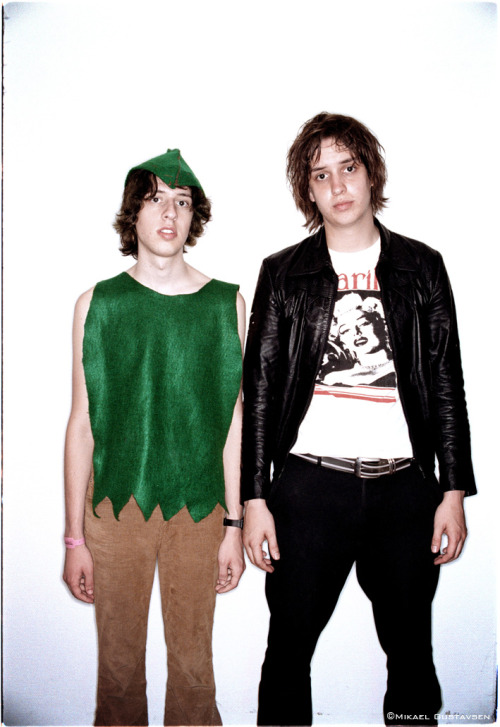
And while we're on Jules whimsy, doesn't Adam Green look like Julian Casablancas' underachieving little bro?
Saturday, 12 January 2013
I have something lovely for you
Writing about Pete Doherty for the last post got me thinking about Babyshambles, which got me thinking about whether Drew McConnell, the Babyshambassist, was making any music of his own again yet. And he is! If I haven't mentioned it often enough, Drew's in a small project called Helsinki, a band which has recorded tracks for Love Music Hate Racism amongst other things, and played a few gigs here and there too. Below is the director's interviews for the track 'Ampersand', a 2010 obsession of mine.
And no post on Helsinki would be complete without posting this frankly unmissable track's video. 'Ribtickling' is, oddly, my most ever played track on last.fm. Ever. Somehow, it's beating everything by Sonic Youth, Bright Eyes, Reuben, The Libertines... I don't know how I racked up so many plays, but see if you can tell why.
Drew has a good voice, idiosyncratic, and if you've ever wondered who's keeping Pete's vocals on track with perfectly sung backing vocals on any of Babyshambles' material, well, it's Drew McConnell. Drew's now releasing some tracks he recorded after a bad accident which broke a few of his bones last year. He's running it alongside a little art project, but the best bit about it is, of course, the music. Tender, reserved, unassuming acoustic music as it is, he's releasing some really nice songs which I strongly recommend. The most recent is this one, 'The Last Boy Alive', which I think has a really subtly gorgeous melody and a touch of that familiar bitter-sweetness I so love.
Friday, 4 January 2013
The Best Pete Doherty Lyrics
"Good artists borrow. Great artists steal." If the saying holds water, then Pete Doherty is the best of artists - from his lyrics to the stuff in his bandmate's flat, Doherty has been a nicker all his working life. Sources state he got offered a place doing English at Oxford Uni, others say the University of London, but either way, it would explain his penchant for putting literary references into his songs - 'A'rébours', Blake's 'Albion', 'Love on the Dole' etc. Recently, he's stolen someone else's career choices. He's made a film, as if to try and out-do Carl Barât in the world of cinema. The two performances (Barât's in Telstar and Doherty's in new film Confession d'un Enfant du Siècle) have little between them as far as terrible delivery of lines is concerned; the key difference is that Pete attempts a leading role. The reviews have ranged from confused to distraught. Watch the trailer below and see if you can work out what it's about.
In a recent interview for The Guardian, Pete Doherty confessed to possibly falling for his own mythology back when he was doing drugs in Camden. Isn't the past tense a bit bold there? Making a French film?! 'What a waster', the world says, except for a few little voices cooing 'he's a sweetie really!', because as this video from when he was released from prison in 2008 demonstrates, the sweetie is sweet from time to time. Look at his little face when he asks the nazi paparazzi if they want to see his journals!
Cruel nasty journalist (mockingly): What does it contain?
Sweetie Petey: Forts... drorins...
... (Pete shows the world a 'Segregation Unit Certificate')
Anyway, I digress. What with his stealing and his strange recent past, Doherty's excellent song-writing can sometimes become lost in the throes of speculation and judgment. Several years ago, I knew him as a 'tabloid whipping-boy' well before I'd heard his voice - a voice which is not the strong point of his music, but idiosyncratic to say the least. What's important is often what that voice is saying. Not many musicians bother writing poetry, whether it's heavily influenced by someone else or not. Here's a run-down of my top five gems.
'Up the Bracket'
Now, it should be mentioned that pretty much all of these tracks were co-written. But, if you compare the lyrics of The Libertines, Doherty and Barât's project, to those of Barât's solo lyrics, it seems clear that most of the good stuff should be attributed to Pete. Since he put pen to paper, Pete's been penning good songs - sometimes. He has definite off-days, but the day he wrote 'Up the Bracket' was not one of them. The title track of their first album, it showcases a little anecdote about Pete being chased by a couple of serious baddies for a friend's address.
I saw two shadow men on the Vallance Roadsaid they'd pay me for your address.
Oh I was so bold...
In three lines, he sets up all the suspense a good story needs. What did he do? What did he do?
I said "you see these two cold fingers?It's great. We get the recounting of an 'oh so bold' reply, of weedy Pete giving them the sign - the sign they should fuck off. The story goes on though, with warm anecdotal flair,These crooked fingers?
They'll show you the way" -
to mean 'no'.
Well they didn't like that much I can tell you,said "sunshine, I wouldn't wanna be in your shoes".
They chased me up two flights of stairs,
caught me in the lift. I sighed and said
"Hello", but you're impossible.
This little scene is perfectly imaginable. Not quite sure what he means by the final lines, but they're expressed with a suitable sigh of futility. It's a good track because, let's face it, we've all heard more love songs than we'd like to shake a stick at, and this is romanticised but totally different from the boring generic love songs constantly played elsewhere.
'Can't Stand Me Now'
Up the Bracket was The Libertines' first album, and all the peace and joy went downhill from there. The light-hearted punk-rock gave way by the time their self-titled second release was made - to self-absorption and harrowing suffering, mostly. Tracks like 'Narcissist' are attempts at recreating the fast-paced carelessness of album number one, but the album gets its fame from the heartache it clearly represents - and discusses, in raw and often very painful detail. 'Can't Stand Me Now' is one of The Libs' most famous tracks, and its lyrics were penned in France when Carl and Pete reunited after Peter's first spell in prison. The first verses are golden:
An ending fitting for the start,you twist and tore our love apart.
Your light fingers through the dark
shattered the lamp, into darkness you cast us.
The first question - is the song about Carl and Pete themselves? It's a question loaded with significance, because the key to the second Libs album for a lot of people is its romance, the way it bares its heart to the world - raw emotion usually so detached and unfamiliar in songs is thrust into the light by the fact we know the story. The magic of these lyrics in particular is that they open the album, with 'an ending', looking back, prophesying the band's untimely break-up. Barât appears to be singing to Doherty, attacking him, blaming him for shattering the lamp of their lives, casting them into darkness. It's traditional imagery but it's well-phrased.
But lo, Pete replies:
No, you've got it the wrong way round,
you shut me up and blamed it on the brown.
Cornered, the boy kicked out at the world...
the world kicked back, a lot fuckin' harder now.
This clearly refers to Barât, destroying the mystery; Barât had Doherty sent to prison in 2004 for breaking into his flat. Pete suggests that it was Carl's fault - 'you shut me up' - and then that Carl tried to shrug the blame by saying it was Pete's drug use causing the problems. The way they immortalise the deadlock of their disagreement is brave - to air their dirty laundry is either a blatant cashing-in on the romance of their story, or songwriting which breaks down the usual boundaries between private and public, the personal lives of the artists and the analytical gaze of the outside world. (Only your personal feeling about the band will determine which angle you take on that.) Doherty turns to some poetic phrasing to give his verse oomph: 'cornered', he begins, placing himself as the passive victim where Barât's verse had been so accusatory. But then he confesses - he did kick, and he got a suitably colloquial kick back. These verses capture both his victim complex and a wry understanding of the way everyone else sees it. As well as being as catchy as Hell, 'Can't Stand Me Now' is a lyrical corpse preserved in formaldehyde, a neat description of the cataclysmic fatal domestic.
'8 Dead Boys'
After The Libertines broke up for what seemed like it would be forever, Pete ran off and wrote some blisteringly mean songs about Barât. The first Babyshambles album is a constant two fingers at Carlos; "Shoop d'lang d'lang", Pete echoes from 'What Katie Did', parodying the innocent friendliness of that Libertines track; "Don't look back into the motherfucking sun" he cries on 'Sticks & Stones', a more obvious reference; one of the songs is even called 'What Katy Did Next', using the convenient literary sequence to move on from The Libs - to open the next book.
'8 Dead Boys' is a particularly vicious track, a masterpiece in sparse punk - here's a great live version.
My favourite lines are at the start of the second verse, and go
If you stop your moaning then they'll give you a taster
They'll give you a line and then call you a waster.
Don't.
You say you will then you won't.
Either you do or you don't - do or you don't.
It's true that the painful, gut-wrenching screams of the song nail home its mood, but these lines encapsulate it too. That taster/waster couplet is another example of Pete placing blame for his way of life on someone else. Pete addresses the audience - it could happen to you, you my friend, that if you go to 'them', whoever they are (we assume his old band, with whom his drug-taking got real), they'll offer you drugs and then accuse you of being the waster. Yes, friends, you. The 'don't' is Doherty's final remark on the matter; he then switches. The 'you' is no longer a cover for himself, an attempt to pull the audience into sympathy; the 'you' assumes the role of the 'they', I think - he addresses his drug-providing pals - don't, because you're unreliable, you lie, and this is your last chance. It's partly appealing because of its rhymes, but I also like its vagueness; he wrote these in a journal or on a scrap piece of paper and they've stayed in tact. That's how it feels. Then he yells, "When it suits you you're a friend of mine", implying that when it doesn't suit them, they're not. Accusatory, angry, powerfully raw - it's what punk used to be about, only more... self-centred.
Shotter's Nation
Album number two brought a much less bitter and more stable range of lyrics into Babyshambles' fans' lives. Personally, I think the album, whilst it is beautifully produced and has some lovely tracks on it, lacks lyrically. It has a few good lines on though, like 'Carry on Up the Morning''s
In the morning where does all the pain go?which is gorgeously easy to empathise with, and witty to boot. Then, there's 'Delivery', withSame place the fame goes - straight to your head
I'm fucked, forlorn, frozen beneath the summer.Don't sing along or you'll get what I got
a grim warning to his fans, telling them off for going to see him play in a cage, which the whole world calls a stage. And then perhaps the denaturalised cliché of 'There She Goes':
How could I let go?
Since I caught a glimpse of your white plimsoles
twisting and turning to Northern Soul.
Just one glance, everybody knows.
I love these, and this album, but like sub-plots in a novel, they don't seem to stick to the story of Pete's life. He has every right to write songs which are about things other than his mighty rise and fall, of course, and he writes great tracks nevertheless, supported by a strong band (even if walk-out guitarist Pat of the first album was a more individual player than this album's Mik).
'New Love Grows on Trees'
And finally, Doherty's solo album. Soft and delicate, it's possibly called 'growing up', only as with most maturing, the lyrics get duller, less impassioned... nostalgic, self-consciously 'British', lots of these songs are sweet and about nothing. Last of the English Roses has a few little crackers in it - "Round the snooker table, you dance the Frutti-Tutti. She almost spilled her lager toasting girls of great beauty" is a nice rhyme, for example, if a little laboured. The magic comes in a song he wrote years before. It is summoned for this release, possibly because its warm reminiscing fits with the character of the album. Peter gently sings,
I don't know why I love these lyrics so much - they just seem to conjure up appealing images, especially of the talking to dead film stars, an endearing quirk in the person the song is written for, whoever it may be. The simple internal rhyme of 'rhymes' and 'crimes' is nice too, just aesthetically. Though the lyrics are very simple, they have an undercurrent of something a bit darker - it's that repetition of 'like you used to' that does it, like a cruel reference to better times, or times when the pair were better acquainted. It's also impatient; as he later says, if you are still doing these things, "you really don't have to".Are you still talking to
all of those dead film stars, like you used to?
And are you still thinking of
all of those pretty rhymes and perfect crimes
like you used to?
The album version is absolutely gorgeous, but it seems appropriate to post this vid, what with its array of pictures of the guy I've spent a good thousand words talking about, so enjoy.
I just hope Pete can recover his writing talent and release some new material, be it with the Babyshambles team or alone. 'Genius' is too strong a word, in my opinion, as perhaps even is 'poet', but Pete Doherty has released some invigorating and wonderful tracks in his time, and some superb lyrics. And he isn't cut out for acting - hopefully the reviews will drive him back into the studio.
Subscribe to:
Posts (Atom)